2.6 Subject Headings
Step 4: Include subject headings
What Are Subject Headings?
As we covered in the Synonyms module, there might be a dozen different ways to say the same thing. Databases recognise this, and have put in a system to try and help! Health databases use 'subject headings' - watch the video to learn more.
Why Use Subject Headings?
When you first start searching, you might wonder why you need to include Subject Headings in addition to keyword synonyms. Here are a few ways subject headings improve your search:
In health databases, all articles are tagged with Subject Headings which describe what an article is about.
This means an article has to be about a certain topic before it's tagged with the associated subject heading. For example, articles about colds will be tagged with "common cold" - so if you use that subject heading, it will bring back articles about the illness.
In contrast, keywords bring back articles with any mention of your term. While your results will contain articles about the illness - you will also get articles discussing the temperature, cold exposure, and hypothermia.
Subject headings are a way of searching by topic.
There is never just one way to express an idea, and health topics are no exception.
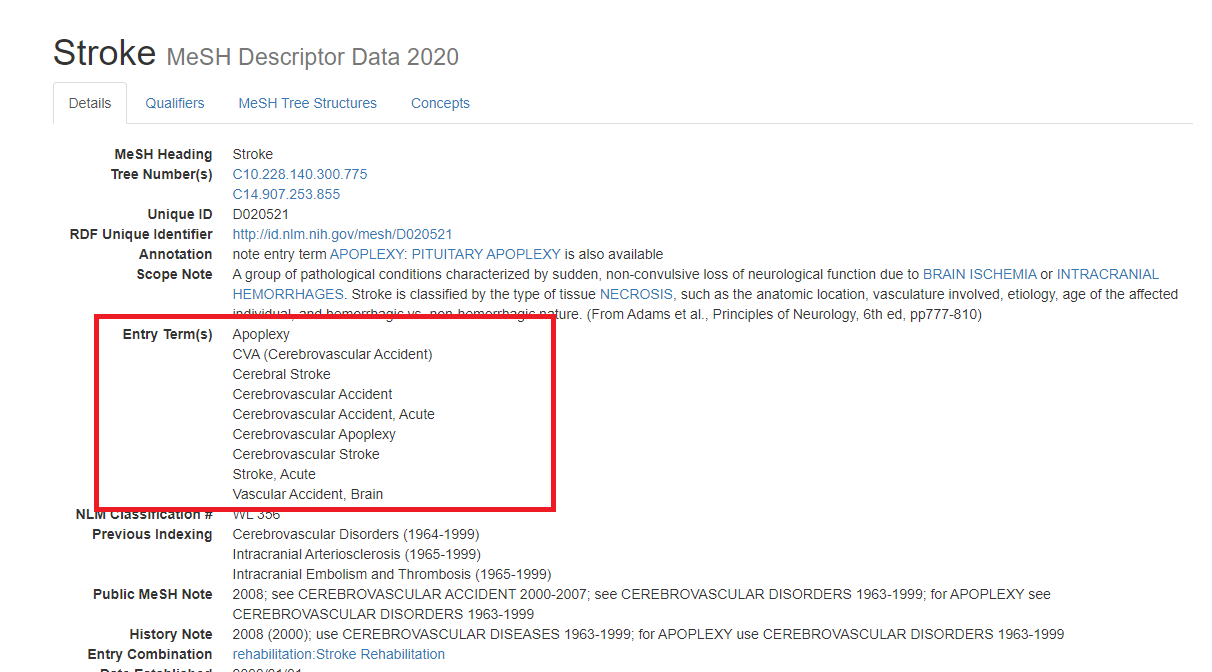
You'll often find that different health researchers use different words for the same symptom, medication, condition, or treatment. For example, the word stroke is the common language word for cerebral stroke, which might also be called cerebrovascular apoplexy or an intracranial embolism.
To make things worse, there are often regional differences in how words are spelled, for example if you did a search for Cognitive Behavioural Therapy you might lose any American results which say Cognitive Behavioral Therapy.
Using subject headings accounts for these differences, and ensures that you capture all possible results.
By including Subject Headings in your search, you will ensure that you only get results that are about your topic, and not results that just mention your topic in passing.
Keyword searches are convenient, but can often find articles that are not relevant to your topic - for example, if an article only mentions "heart attacks" once it probably won't be useful to your search on the long-term health outcomes of heart attack patients.
Subject headings will describe an article's main topics, so you know the article will be relevant.
Where to Find Subject Headings?
Different health databases will use their own subject headings.
Medline and PubMed use a version of subject headings called MeSH (Medical Subject Headings). PsycINFO and CINAHL use an adapted version of MeSH which is more discipline specific.
You can look up subject headings during the search planning phase by using the MeSH browser. The MeSH browser is also a good place to find synonyms for your search terms (see the highlighted section in the image below).
In health databases like Medline, PsycINFO, CINAHL and Embase, there is a way for the database to suggest subject headings to you. We will cover this in the next page and also show you in the next module.