1.4 The Evidence Based Practice Hierarchy
What is Evidence Based Practice?
Evidence Based Practice (EBP) is an approach to decision-making in patient care.
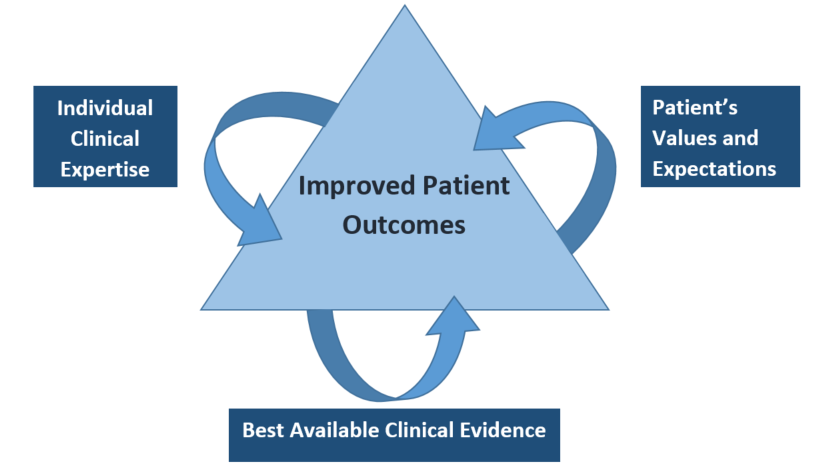
It seeks to prioritise:
- The expertise of the clinician (e.g. you, your team leader, supervisor etc)
- The needs, wants and personal history of the patient
- The highest quality evidence available on the issue or subject
Strauss, S. (2005). Evidence-based medicine: how to practice and teach EBM (3rd ed.). Churchill Livingstone.
The Hierarchy of Evidence
Research can vary in authority and reliability. Many clinicians use the EBP pyramid as a rule of thumb to decide which study types can best answer their questions. As we move up the triangle, the literature increases in relevance in the clinical setting. Research in the top tiers involves bringing together evidence across multiple studies. This means the evidence is stronger, and findings are more applicable to a wider population.
Click on the + symbols on each tier to learn more about them.
How to use the hierarchy of evidence
Here are two ways you might use the pyramid to gather the highest quality evidence.
- Selection: You might begin a search with a pyramid tier in mind (e.g. "I only want to look at Randomised Controlled Trials", or "I will consider case reports, observational studies and RCTs", or "I need a systematic review to answer this question adequately")
- Comparison: You can use the pyramid if two pieces of evidence conflict, e.g. "This observational study says 'x', but this systematic review says 'y'. I'll go with the systematic review, because it pulled together 45 different studies.